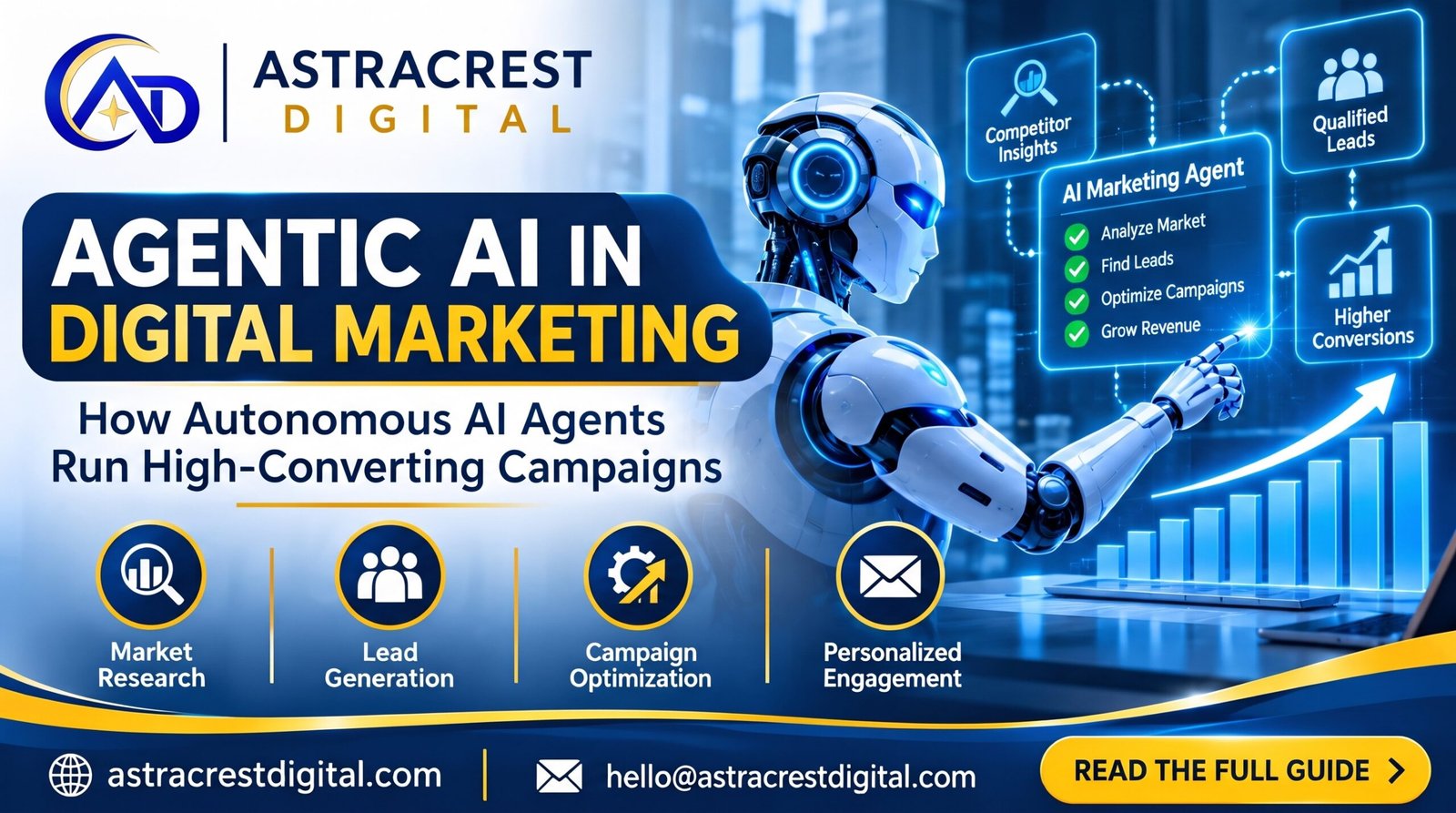
Agentic AI in digital marketing is changing how businesses research competitors, generate qualified leads, manage campaigns, and engage customers. Instead of relying entirely on manual instructions and disconnected marketing tools, businesses can now use intelligent AI agents to coordinate multiple tasks, evaluate information, and execute defined actions with appropriate human supervision.
For years, artificial intelligence in marketing primarily meant content generation. Marketers used AI tools to write blog outlines, create social media captions, develop email subject lines, and generate advertising ideas.
Although these capabilities made content production faster, they did not eliminate many time-consuming marketing activities. Teams still spent hours researching competitors, qualifying leads, monitoring campaigns, reviewing analytics, and updating customer relationship management (CRM) systems.
Now, a new development is changing this approach: agentic marketing.
Unlike traditional AI tools that respond to individual prompts, autonomous AI marketing agents can work toward defined objectives, use connected software tools, complete multiple steps, and evaluate results within established permissions.
For example, imagine giving a marketing system an objective: identify qualified B2B prospects, research their companies, prepare personalized outreach, and update the CRM. Rather than manually coordinating every step, an AI agent can handle much of the repetitive execution while keeping important decisions under human supervision.
In this guide, we’ll explore how agentic AI in digital marketing works, how it differs from generative AI and traditional automation, and how businesses can use autonomous systems to build more efficient customer acquisition processes.
What Is Agentic AI in Digital Marketing?
Agentic AI refers to AI-powered systems that can interpret objectives, evaluate available information, plan actions, use connected tools, and execute multi-step tasks within defined boundaries.
In digital marketing, these systems can support activities such as:
- Competitor and market research.
- Lead identification and qualification.
- Personalized customer communication.
- Campaign performance analysis.
- Content planning and distribution.
- Marketing reporting and optimization.
Traditional marketing software usually follows predefined instructions. Generative AI creates content in response to a request. However, agentic AI combines reasoning, tool usage, and task execution to work toward a broader objective.
For example, a conventional AI writing tool might generate an email introducing your services. An AI marketing agent could research the prospect’s company, identify relevant business information, check CRM records, prepare a personalized email, and submit it for approval.
Consequently, the agent participates in the overall marketing workflow rather than simply producing an isolated piece of content.
How Agentic AI in Digital Marketing Differs from Traditional Automation
Understanding these technologies helps businesses identify where autonomous systems provide additional value.
| Technology | How it works | Marketing example |
|---|---|---|
| Rule-based automation | Executes predefined triggers and actions | Add a new inquiry to a CRM |
| Generative AI | Produces content based on instructions | Write a personalized email draft |
| Agentic AI | Plans and executes connected tasks toward an objective | Research a lead, assess fit, prepare outreach, and update CRM records |
These technologies are not necessarily competing alternatives. In fact, they can work together.
For instance, traditional automation can handle predictable data transfers, generative AI can create marketing content, and an AI agent can coordinate a broader process that uses both.
The result is a more connected marketing operation with fewer manual handoffs.
Generative AI vs. Agentic AI: What’s the Difference?
The difference becomes clearer when comparing how each technology handles a marketing objective.
| Marketing function | Generative AI | Agentic AI |
|---|---|---|
| Research | Summarizes information provided or retrieved | Coordinates research across approved sources |
| Content creation | Generates individual content pieces | Plans and prepares multi-channel content workflows |
| Lead generation | Suggests prospecting messages | Researches, evaluates, and routes prospects |
| Campaign management | Recommends improvements | Monitors results and executes approved changes |
| Reporting | Summarizes performance data | Tracks KPIs and initiates appropriate follow-up actions |
| Customer engagement | Drafts responses | Coordinates personalized communication within approved rules |
However, agentic AI does not automatically make every marketing activity better. Results depend on the quality of connected data, available tools, instructions, and operational boundaries.
Why Agentic AI in Digital Marketing Is Gaining Attention in 2026
The growing interest in agentic marketing reflects a broader shift from experimenting with individual AI tools toward connecting AI capabilities to measurable business processes.
McKinsey’s research on agentic AI in B2B sales describes how organizations can connect data, decision logic, human judgment, and AI agents across commercial activities.
At the same time, adoption at scale remains relatively early. Therefore, businesses should focus on practical applications rather than assuming that fully autonomous marketing departments are already commonplace.
Amazon Ads has also introduced agentic AI capabilities into its advertising platform, demonstrating how these technologies are entering commercial marketing environments.
These developments suggest that agentic systems are becoming increasingly relevant to businesses looking to improve marketing efficiency.
Explore these external resources:
4 High-Impact Agentic AI in Digital Marketing Applications
Businesses do not need to automate every marketing function simultaneously. Instead, starting with specific, repetitive tasks can make implementation easier to manage and measure.
Here are four practical applications.
1. Competitive Intelligence Agents for Digital Marketing
Competitive research often involves reviewing search engine results, competitor websites, advertising messages, social media activity, and industry developments.
An AI competitive intelligence agent can help organize this process.
It can:
- Monitor approved competitor websites and public marketing information.
- Identify changes in competitor positioning and service offerings.
- Collect relevant industry developments.
- Identify potential content opportunities.
- Prepare competitor comparison reports.
- Deliver research summaries to marketing teams.
For example, a B2B company could configure an agent to prepare a weekly competitor intelligence report covering new service pages, content topics, advertising messages, and emerging customer concerns.
As a result, the marketing team can use those findings to develop a stronger content strategy.
Combining market intelligence with a structured SEO strategy helps businesses turn research findings into useful content and search visibility opportunities.
2. AI Agent Lead Generation and Qualification
Finding potential customers is only the beginning of lead generation. Businesses must also determine which prospects match their ideal customer profile (ICP), understand their requirements, and follow up appropriately.
An AI lead generation agent can support this process.
A typical workflow could include:
- Identify potential companies using approved business databases and public sources.
- Research company size, industry, services, and relevant business signals.
- Compare available information against predefined qualification criteria.
- Assign a lead score based on company fit and buying signals.
- Prepare a personalized outreach draft.
- Update the CRM with research findings and recommended next steps.
- Notify the sales team when a prospect requires human attention.
Consequently, sales teams can spend less time on repetitive prospect research and more time engaging relevant opportunities.
For businesses exploring connected business processes, our guide to AI workflow automation explains how automated workflows can connect business applications and reduce manual tasks.
3. Campaign Monitoring and Optimization Agents
Digital advertising requires regular attention. Marketing teams need to monitor impressions, clicks, conversions, cost per acquisition (CPA), and return on advertising spend.
An AI campaign optimization agent can help analyze these signals and identify opportunities.
Possible activities include:
- Monitoring campaign performance against predefined KPIs.
- Identifying advertisements with declining engagement.
- Comparing creative variations.
- Flagging unusual spending patterns.
- Recommending budget adjustments.
- Preparing new A/B testing suggestions.
- Generating performance summaries.
For example, an agent could identify that one campaign variation consistently has a higher cost per qualified lead than another.
It could then recommend pausing the weaker variation or reallocating part of the budget.
Nevertheless, changes involving advertising spend should follow predefined limits and approval requirements. Businesses should not give AI systems unrestricted access to advertising budgets.
4. Personalized Email and Customer Engagement Agents
Generic marketing messages often fail to address the specific interests and requirements of individual customers.
AI personalization agents can help businesses develop more relevant communication.
A properly configured system can:
- Organize prospects according to their interests.
- Review permitted CRM interaction history.
- Identify relevant services or content.
- Prepare personalized email drafts.
- Schedule approved follow-up sequences.
- Detect customer replies and pause automated messaging.
- Notify sales representatives when personal attention is needed.
For example, someone who downloads a guide about website performance may receive a different follow-up sequence from someone who requests information about AI workflow automation.
Therefore, the objective is not simply to send more emails. It is to make communication more relevant and timely.
Our guide to AI marketing automation for small businesses explores additional ways businesses can automate repetitive marketing activities while maintaining human oversight.
How Multiple AI Agents Work Together in an Autonomous Marketing System
The real potential of agentic AI in digital marketing becomes clearer when specialized agents work together.
Rather than asking one AI system to perform every marketing function, businesses can assign different responsibilities to specialized agents.
Consider this example:
Step 1: Market Research Agent
Collects approved industry information, reviews competitor activity, and identifies potential market opportunities.
Step 2: Content Strategy Agent
Uses research findings to recommend relevant topics, campaign messages, and content formats.
Step 3: Lead Intelligence Agent
Identifies potential customers, researches their businesses, and evaluates their fit against predefined criteria.
Step 4: Campaign Management Agent
Prepares campaign variations, monitors performance, and recommends improvements.
Step 5: Reporting Agent
Combines campaign and lead information into a report showing performance, opportunities, and recommended next steps.
The agents can exchange information through connected applications, APIs, and workflow orchestration systems.
However, a human marketing manager remains responsible for strategic direction, brand positioning, final approvals, and important business decisions.
This coordinated approach makes agentic marketing more useful than relying on disconnected AI tools.
Human-in-the-Loop: Responsible Agentic AI in Digital Marketing
Autonomous execution does not mean removing people from marketing decisions.
AI agents can make mistakes, misunderstand business context, produce inaccurate information, or act on incomplete data. Without appropriate safeguards, these issues can affect customer relationships, advertising budgets, and brand reputation.
A human-in-the-loop (HITL) framework helps businesses maintain control.
1. Strategic Guardrails
Define brand guidelines, target audiences, approved messaging, pricing restrictions, data permissions, and campaign objectives before deploying an agent.
2. Approval Checkpoints
Require human approval for important actions, including publishing campaigns, sending sensitive outreach, changing significant advertising budgets, or modifying customer records.
3. Access Controls
Give each agent only the permissions required for its assigned responsibilities. In addition, avoid unnecessary access to sensitive business information.
4. Audit Trails and Performance Monitoring
Maintain records of agent activities, decisions, tool usage, approvals, and campaign changes. Review performance regularly and provide a way to pause or reverse automated actions.
Google also emphasizes the importance of accurate, helpful, people-first content. Its guidance explains that using generative AI is not inherently a problem. However, producing large amounts of low-value content without meaningful human review can violate its scaled content abuse policies.
Read Google’s official guidance:
- Google Search Central – Creating Helpful, Reliable, People-First Content
- Google Search Central – Guidance on Generative AI Content
Ultimately, the goal should be responsible automation that improves the quality and efficiency of marketing operations.
How to Implement Agentic AI in Digital Marketing: A Practical Starting Framework
Businesses interested in agentic AI should begin with a clear operational objective rather than purchasing multiple AI subscriptions without a defined implementation plan.
A practical starting framework includes six steps.
Step 1: Identify a Repetitive Marketing Process
Look for activities that consume significant time, follow predictable patterns, and have measurable outcomes.
Examples include lead research, CRM updates, campaign reporting, and content preparation.
Step 2: Define the Business Objective
Establish what the agent should accomplish.
For example, reduce manual prospect research time, improve lead response speed, or generate more consistent campaign performance reports.
Step 3: Select the Right Tools and Integrations
Determine which CRM, marketing platforms, databases, analytics tools, and communication systems the agent needs to access.
Step 4: Establish Permissions and Approval Rules
Define which actions the agent can complete independently and which require human approval.
Step 5: Run a Controlled Pilot
Start with one workflow, test it using real business scenarios, and monitor accuracy, efficiency, reliability, and cost.
Step 6: Measure Results Before Expanding
Compare performance against the original process. Once the initial implementation demonstrates measurable value, expand to additional workflows.
This approach helps businesses avoid unnecessary complexity and build an AI marketing infrastructure that can grow with their requirements.
Build Your Agentic AI in Digital Marketing Strategy with AstraCrest Digital
The future of digital marketing is not simply about generating more content or adding another automation tool.
Instead, it is about connecting research, marketing strategy, lead generation, customer engagement, and performance measurement into intelligent business systems.
At AstraCrest Digital, we help businesses develop practical digital solutions that connect technology with measurable business objectives.
Our capabilities include:
- Custom AI Agents: Intelligent systems designed around specific business objectives and operational requirements.
- AI Workflow Automation: Connected workflows that reduce repetitive tasks and manual handoffs.
- AI Marketing Automation: Smarter marketing processes for lead management, customer engagement, and campaign coordination.
- WordPress Website Design: Professional websites built to support brand credibility, user experience, and business growth.
- SEO and Digital Marketing: Strategies that strengthen online visibility and help businesses reach relevant audiences.
- Launch360: A connected growth approach combining digital presence, marketing systems, and business development.
Whether you want to improve lead qualification, automate competitor research, coordinate marketing campaigns, or explore custom AI agents, the right starting point is understanding your business process.
Ready to explore what agentic AI could do for your business?
Let’s identify the right opportunities and build a practical roadmap for your next stage of growth.
Start a conversation with AstraCrest Digital.
Website: https://astracrestdigital.com/
Email: hello@astracrestdigital.com
Frequently Asked Questions About Agentic AI in Digital Marketing
1. What is agentic AI in digital marketing?
Agentic AI in digital marketing refers to AI-powered systems that can interpret objectives, plan tasks, use connected software tools, and execute multi-step marketing activities within defined permissions.
2. What is the difference between generative AI and agentic AI?
Generative AI primarily creates content such as text, images, and marketing ideas in response to instructions. In contrast, agentic AI can coordinate multiple tasks, interact with connected tools, and take actions toward a defined objective.
3. How do AI marketing agents help with lead generation?
AI marketing agents can research companies, evaluate prospects against predefined qualification criteria, prepare personalized outreach, organize CRM information, and notify sales teams about qualified opportunities.
4. Can agentic AI manage advertising campaigns?
Agentic AI can assist with campaign research, performance monitoring, creative testing, and optimization recommendations. Depending on its permissions and platform integrations, it may also execute approved changes under predefined budget and performance limits.
5. Is agentic AI suitable for small businesses?
Yes. Small businesses can start with focused applications such as lead research, customer inquiry classification, marketing reporting, and personalized follow-up. A controlled pilot is generally more practical than attempting to automate every marketing activity.
6. Does agentic AI replace digital marketing professionals?
No. Agentic AI can reduce repetitive execution work, but human professionals remain important for strategy, creativity, customer relationships, brand positioning, compliance, and business decisions.
7. How can a business get started with agentic marketing?
Start by identifying a repetitive marketing task, defining a measurable objective, selecting the necessary integrations, establishing approval rules, and testing the system through a controlled pilot.
Final Thoughts
Agentic AI is creating new possibilities for businesses that want to move beyond disconnected marketing tools and repetitive manual processes.
From competitor intelligence and AI agent lead generation to campaign monitoring and personalized customer engagement, specialized agents can help coordinate complex marketing activities.
However, successful implementation requires more than advanced technology. Businesses need clear objectives, reliable data, appropriate integrations, measurable performance indicators, and human oversight.
The best approach is to start with one meaningful business problem, build a controlled solution, and expand as the results become clear.
A smarter marketing operation begins with the right system—not simply more tools.